Council Tax increase
The government has cut Wandsworth funding by 40%, the worst cash settlement in the country. This cut of £84 million per year is matched by the considerable spend we inherited and is more than all our spending on parks, libraries, leisure centres, bin collection and street cleaning. Other pressures include inflation costs and rising demand for local services.
Challenging the settlement
The Council will challenge the funding settlement under the Sustainable Communities Act. For our formal challenge to have the best chance of success, we need your help.
If we are unable to change the settlement
If we are unable to get the government to think again, local bills will increase. Given the scale of the increase, we are giving you as much notice as possible.
Wandsworth’s tax would still be low compared to other London boroughs, and we will continue to work to keep your bill down.
Why is Council Tax increasing?
Wandsworth is facing substantial financial pressures.
The main reason for the increase is a substantial reduction in government funding through changes to the way councils are funded nationally. As part of the government's Fair Funding Review, funding is being redistributed to areas judged to have higher levels of need.
Our funding has already started to reduce, by £19m a year in 2026/27, which will become an £84m a year reduction by 2029. This is equivalent to 40% of our total income. At the same time, demand and costs for essential services continue to rise.
Despite carrying out a comprehensive review of spending, identifying savings and efficiencies, and exploring ways to reduce costs, additional income is needed to maintain the services residents rely on.
Is there anything we can do to prevent this?
The Council will challenge the funding settlement under the Sustainable Communities Act.
For our formal challenge to have the best chance of success, we need your help. Please respond to the consultation, which will inform our challenge.
Has the increase already been approved?
No.
The figures in your letter are based on the Council's current financial planning assumptions and represent the expected scale of the increase required to address the funding gap.
The final Council Tax level for 2027/28 will be determined through the Council's formal budget-setting process in February 2027, and subject to full council agreement in early March 2027.
If you receive a discount, exemption, Council Tax support or are subject to a premium, the amount you actually pay may be different from the figures shown.
The Council continues to explore all options to reduce the need for an increase and keep any rise as low as possible.
How do we compare with neighbouring boroughs?
Even with this increase, Wandsworth Council Tax will remain broadly in line with neighbouring boroughs.
For comparison:
- Wandsworth Band D in 2027/28 would be £1,978
- A Band D property in Lambeth in 2026/27 pays £2,047.11
- A Band D property in Merton in 2026/27 pays £2,140.52
What are the proposed amounts for each band?
| Band | Current total | Increase | New total |
| A | £680 | £639 | £1,319 |
| B | £794 | £745 | £1,539 |
| C | £907 | £852 | £1,759 |
| D | £1,020 | £958 | £1,978 |
| E | £1,247 | £1,171 | £2,418 |
| F | £1,474 | £1,384 | £2,858 |
| G | £1,701 | £1,597 | £3,297 |
| H | £2,041 | £1,916 | £3,957 |
If your Council Tax bill is subject to any discount, exemption, support scheme or premium, the figures shown above may not reflect the amount you actually pay. Premiums apply to second homes and empty properties.
What is causing the Council Tax increase?
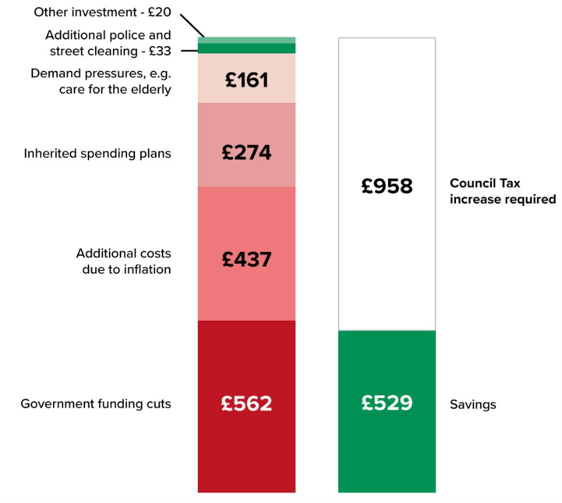
The new administration has run a full Spending Review to address the Council’s financial crisis, producing £79 million in annual savings (which equates to around £529 for every household in the borough).
Unfortunately, these difficult choices will not close Wandsworth’s budget gap. For a Band D bill, this leaves £958 to be found through Council Tax after savings:
Are there other options, instead of putting Council Tax up?
No. The government’s Fairer Funding review has calculated how much funding Wandsworth will lose, and those calculations have included an assumption that Council Tax will increase. If we do not increase Council Tax, we will be left with a larger financial gap than we can cover.
Before proposing any increase to Council Tax, the Council has undertaken a comprehensive review of its spending, identified savings and efficiencies wherever possible, and looked at every opportunity to reduce costs. Despite these efforts, additional income is required to continue delivering the services residents rely on every day.
What is the Council doing to avoid increasing Council Tax?
The Council has undertaken a comprehensive review of its finances and continues to:
- Identify savings and efficiencies
- Reduce costs where possible
- Explore opportunities to generate income from other sources
- Review spending priorities
- Challenge the government's funding settlement
The Council remains committed to keeping Council Tax as low as possible while protecting essential services.
Why can't the Council simply make more savings instead?
The Council has already identified and delivered significant savings and efficiencies over many years.
However, the scale of the funding reductions and rising service costs means that savings alone are not sufficient to close the budget gap while maintaining essential services.
Residents are invited to share their views on future spending priorities and possible areas for further savings through the Council's engagement survey.
Why are you telling residents so far in advance?
We believe residents should have as much notice as possible of significant changes that may affect household finances.
Providing advance notice supports transparency and gives households more time to plan, budget and understand the reasons behind the proposed increase.
How much will this increase raise?
Currently the borough’s share of Council Tax generates a net £77 million a year for the council. The total additional amount raised by this tax increase will be £132 million in 2027/28.
My bill includes a discount, exemption, support or premium. Does this letter reflect what I actually pay?
No. The figures shown in the letter are based on the standard Council Tax charge for your property band, without any reductions or premiums.
If you receive a discount, exemption, Council Tax support or are subject to a premium, the amount you actually pay may be different from the figures shown.
Your new annual bill will be sent in March for the next financial year, and this will show the charges and any reductions that apply to your circumstances.
What if my household struggles to pay the increased Council Tax?
Support is available for some residents who are on a low income or experiencing financial hardship.
You may be eligible for means-tested Council Tax Reduction (CTR) or other forms of assistance. Information about eligibility, a benefit calculator which can provide an estimate of your entitlement to CTR and how to apply can be found on the Benefits and support pages.
Other non-means-tested reductions are also available, as is the option to move to paying over 12 months instead of 10.
If you are concerned about paying your bill, we encourage you to visit the above pages to find out of any of the schemes fit your circumstances, and then to seek advice as early as possible rather than waiting until payment becomes difficult.
How can I share my views?
Residents can take part in the Council's engagement survey and provide feedback on spending priorities and potential savings.
This is also where you can show your support for our proposal to challenge the government for a fairer funding deal for Wandsworth.
I have recently moved. Why have I received this letter?
The letter has been sent to the person currently recorded as the primary Council Tax account holder for the property at the time the mailing was prepared.
If your circumstances have changed, please ensure your Council Tax account details are up to date.
You may have already informed us that you have moved, and we are waiting to action this. If you have not already done so, tell us you're moving.
Why is just my name on this letter?
Although the letter is addressed to the primary account holder, everyone named on the Council Tax bill is jointly and severally liable for the charge. This means each person named on the bill is legally responsible for ensuring the full amount is paid.
Why is the Council proposing such a large Council Tax increase?
Wandsworth faces a significant and recurring budget gap. The government has cut its funding to Wandsworth by £19 million in 2026/27 rising to £84m a year. There are also inflationary pressures and increasing demand for statutory services such as social care and homelessness support.
The Council's published figures indicate that by 2030 the funding shortfall comprises approximately £84 million from government grant funding changes, £65 million from inflation, £41 million from an inherited budget gap, and £24 million from increased demand for services.
The Council's position is that both savings and additional income are required to address these pressures while maintaining essential services.
Why has the government changed the funding system?
The government has undertaken a review of local government funding with the stated aim of "reconnecting funding with need" and redistributing resources towards councils that it considers to have greater spending pressures and less ability to raise income locally. Under the revised funding methodology, the government assesses councils' ability to raise income from Council Tax using a notional council tax level closer to the national average.
The Council's view is that this approach disproportionately affects authorities such as Wandsworth, which have historically maintained lower Council Tax levels. The Council has argued that it is being penalised for having low Council Tax and strong financial management, while the government's position is that the reforms are intended to make funding allocations fairer and more closely aligned to need across the country.
Why can't the Council simply use its reserves instead of increasing Council Tax?
Reserves are not a sustainable source of funding for ongoing expenditure because they can only be spent once. The Council has advised that it is already using substantial reserves to balance the budget, including approximately £50 million in 2026/27 alone.
In addition, much of the headline reserves figure is not available for general spending because it is legally restricted or earmarked for specific purposes such as housing, capital projects, developer contributions and other committed expenditure. The amount available to support day-to-day services is therefore significantly lower than the total reserves reported in the annual accounts.
Whilst using more reserves could reduce or delay some Council Tax increases in the short term, it would not remove the underlying budget gap. Once reserves are exhausted, the Council would still need to address the same recurring financial pressures through savings, income generation or Council Tax.
How much of the Council's reserves are available for general spending?
The Council's accounts include a range of reserves held for different purposes. Many of these are restricted by legislation or committed to specific projects and cannot be used to fund day-to-day services. The Council has stated that the reserves available to support general services have been reducing as they have been used to balance recent budgets.
Maintaining an adequate level of reserves is an important part of ensuring the Council’s finances are sound. They provide protection against unexpected pressures or events, allow the Council manage risk and can support one off investment where this helps reduce future costs.
Further details on the composition of reserves are available in the Council's Statement of Accounts and Medium Term Financial Strategy.
Why is the Council seeking to retain reserves rather than spend more of them now?
Why is the Council seeking to retain reserves rather than spend more of them now?
The Council considers it prudent to maintain an appropriate level of reserves to manage financial risks, unexpected events and future uncertainty. Maintaining an adequate level of reserves is an important part of ensuring the Council’s finances are sound. They provide protection against unexpected pressures or events, allow the Council manage risk and can support one off investment where this helps reduce future costs.
Using reserves to fund recurring expenditure on an ongoing basis would reduce the Council's financial resilience and could increase the risk of more significant financial difficulties in future years.
Could the increase have been phased over a longer period?
The government has indicated that the normal referendum limits on Council Tax increases will not apply to a small number of low-tax authorities, including Wandsworth, for a limited period. The Council has considered options for phasing changes over more than one year.
However, its position is that doing so would require substantially greater use of reserves and would leave the Council with significantly reduced financial resilience.
If government grant funding reductions are £84 million, why is the Council Tax increase larger than that?
The government grant funding reduction is only one component of the Council's financial challenge. The Council has explained that inflation, demand growth in statutory services, an inherited budget gap and other financial pressures also contribute to the overall budget gap.
As a result, the proposed Council Tax increase is intended to address both the impact of reduced government funding and the wider financial pressures facing the Council.
How was the inflation figure of £437 calculated?
The £437 figure referred to in the explanatory letter represents how much of a Band D increase is caused by inflation. The published material explains that inflation accounts for approximately £65 million of the Council's projected financial challenge by 2030.
The inflation projection covers the next four years and is calculated by applying relevant inflation assumptions to the different categories of Council expenditure e.g. contracts, energy and fuel, care provider charges.
This produces a weighted average inflation rate of 2.8% for 2026/27 and 2027/28, with 2.5% assumed in each year thereafter. Pay increases for staff are set nationally, not by the Council, and are assumed in the projections to be 2.5% each year.
General inflation (CPI) is currently 3.1%.
Why are services being reduced at the same time as Council Tax is increasing?
The Council's view is that the scale of the financial challenge cannot be addressed through any single measure. It has therefore proposed a combination of service efficiencies, improving the way services are delivered including through digitalisation, income generation initiatives and higher Council Tax.
The Spending Review identifies approximately £79 million of savings by 2030 alongside the proposed Council Tax increase.
What is included within the £79 million savings target?
The Council has explained that the £79 million savings programme includes improving services through digitalisation, efficiencies, service redesign and income generation measures. Some services have been paused, scaled back or stopped. The published information also notes that some future savings are still being developed and carry delivery risks.
More detailed information on individual savings proposals will be presented through future budget and Spending Review update reports.
What assessment has been made of the impact on residents?
The Council recognises that any increase in Council Tax will affect household finances. As part of the budget-setting process, consideration is given to the impact on residents, particularly low-income households and vulnerable residents. Support continues to be available through Council Tax Reduction scheme, payment arrangements and wider financial support services. Information on available support has been included alongside communications about the proposed changes.
The Council Tax Reduction Scheme is being reviewed to ensure support remains focused on residents who need it most and remains affordable to the Council. Any changes are subject to public consultation and will be introduced through a phased transition, with clear information and support to help affected households adjust.
What consideration was given to ensuring the communication was politically neutral?
The Council has a duty to comply with the Local Government Act 1986 and the statutory Code of Recommended Practice on Local Authority Publicity. Communications are reviewed to ensure that they are factual, accurate, relevant to Council business and do not seek to promote or oppose any political party.
The purpose of the letter is to explain a significant potential change affecting residents and the factors which the Council believes are contributing to that change, and to give residents as much notice as possible of the potential change so they can plan ahead.